Suggested searches
Welcome to the second edition of Safe to Trade Data Insights, a feature that we hope will help you on your food safety and health and safety journey. Today’s article takes a look at allergens, not the highest driver of non-conformances from Safe to Trade audits but certainly amongst those that can lead to some of the most serious consequences for consumers.
Safe to Trade is a voluntary third-party assurance (vTPA) programme for hospitality and catering designed to provide assurance about the businesses’ commitment and compliance to food safety, hygiene and food standards. Non-conformance data from audits to the Safe to Trade Standard provide valuable insight into common challenges that the industry faces. The Technical Standards Committee (TSC) of Safe to Trade reviews the data and associated trends to identify learnings and, as Chair of the TSC, I hope that by sharing this with you we can collectively strengthen the resilience of the food system.
Food allergy and intolerance is a serious issue for many individuals and a recent report commissioned by the Food Standards Agency on “Patterns and Prevalence of Adult Food Allergy (PAFA)” identified that over 30% of adults reported an adverse reaction following the consumption of food. Further investigation involving clinical assessment determined that an estimated 6% of the UK adult population had a clinically confirmed food allergy, equating to around 2.4 million adults in the UK. Food allergy often develops in childhood and persists into early adulthood, but it is notable that around half of food allergies develop in later adulthood. Although many food allergies can be mild, serious anaphylaxis can occur in those with extreme allergy and this continues to result in
fatalities due to products or menu items that are improperly labelled or poorly controlled. Allergen mislabelling is the leading driver of food recalls in many countries.
The legislative position regarding allergen management is clearly defined in country specific regulations including the requirement to label products with the 14 mandatory allergens. Food business operators in retail, hospitality and catering must provide allergen information to the consumer for prepacked and non-prepacked food and must also handle and manage allergens effectively in food preparation. This also extends to training of staff on allergens. Detailed guidance on legislative requirements for allergen management is available from the Food Standards Agency (Allergen Guidance for Food Businesses) and guidance also exists where potential allergen cross contamination may necessitate warning the consumer of such risks (Precautionary Allergen Labelling). Industry guidance is available for situations where free-from or gluten-free claims are being used and for allergen-free and vegan claims.
Notwithstanding the legal requirements regarding allergen management, it goes without saying that with such a high proportion of the population suffering food allergy, consumers place a heavy emphasis on the effective management of allergens in food businesses and express this in the choice of products they buy and the hospitality and catering establishments they visit. And of course, this choice extends well beyond the individual with an allergy themselves but to the entire group eating the same product or meal.
The Safe to Trade Standard has seven sections relating to food safety that comprise 49 clauses, each of which has specific audit requirements. The top five clauses with the highest non-conformances from Safe to Trade audits are shown in Table 1 and the clause driving by far the largest number of non-conformances is “Date Labelling & Stock Rotation” representing 12%. This has remained the top reason since the Safe to Trade programme was introduced in 2023.
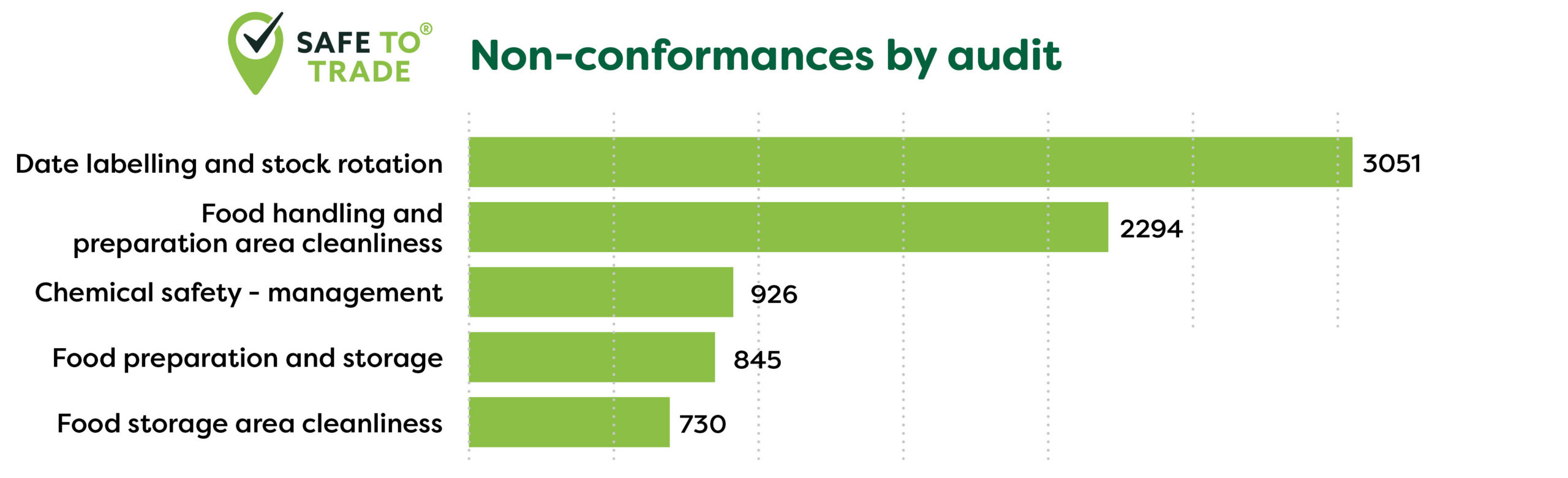
Allergen management is not amongst the top five drivers of non-conformances but it is arguably one that has the most serious immediate consequence for the consumer.
Recognising its growing importance to consumers, the Safe to Trade programme was specifically developed to include allergen management as a key audit focus. This also reflected that the issue of allergen safety is not directly covered by the Food Hygiene Rating Scheme (FHRS). Safe to Trade has five specific clauses relating to allergen management and the relative non-conformances in each are detailed in Table 2.
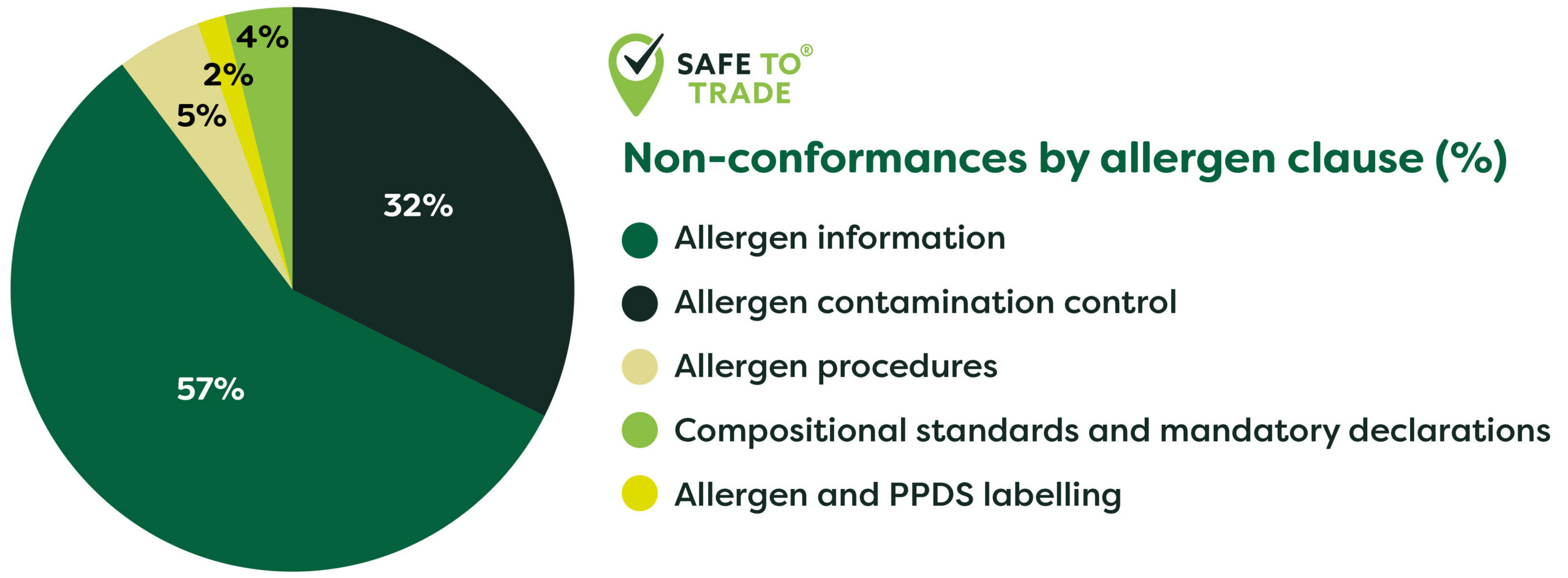
Delving a bit deeper, there have been 765 non-conformances in relation to the allergen requirements since January 2023 and these broadly fall into two key areas; allergen information and allergen contamination risk.
Allergen information non-conformances: Looking at allergen information, the highest number of non-conformances (151 instances) was due to “Allergen information not available / not fully complete” together with such information “Not reviewed” (48 instances). There were also 44 instances of “No / insufficient allergen information signposted to customers” and it is also noteworthy that there has been an increase of 42% in these non-conformances in the last 6 months. Further analysis of the data shows that, although in many cases the allergen category was highlighted in allergen matrices, the specific allergen was not with 81 instances of specific cereals containing gluten not declared and 42 instances of the specific nut not declared. There were 63 instances of “Allergen information not accurate” and perhaps the most alarming were the 5 instances where an allergen was present in food but not declared on a matrix or via the method used to communicate to customers. It is important to note that in situations such as these, where there is an imminent risk, the Safe to Trade audit requires immediate rectification of the issue as part of the programme.
Allergen contamination risk non-conformances: In relation to nonconformances associated with processes or procedures leading to a potential risk of allergen contamination, the highest driver was “Allergens not separate” (149 instances), which was evidenced in areas such as bars, kitchen storage or food preparation areas. There were 76 incidences of “Inadequate handling practices pose risk of allergen contamination” with a specific example being the use of the same tongs or equipment to handle allergen dishes and non-allergen dishes. A particular pattern of milk contamination to jugs or via improper cleaning of steam wands on coffee machines was seen.
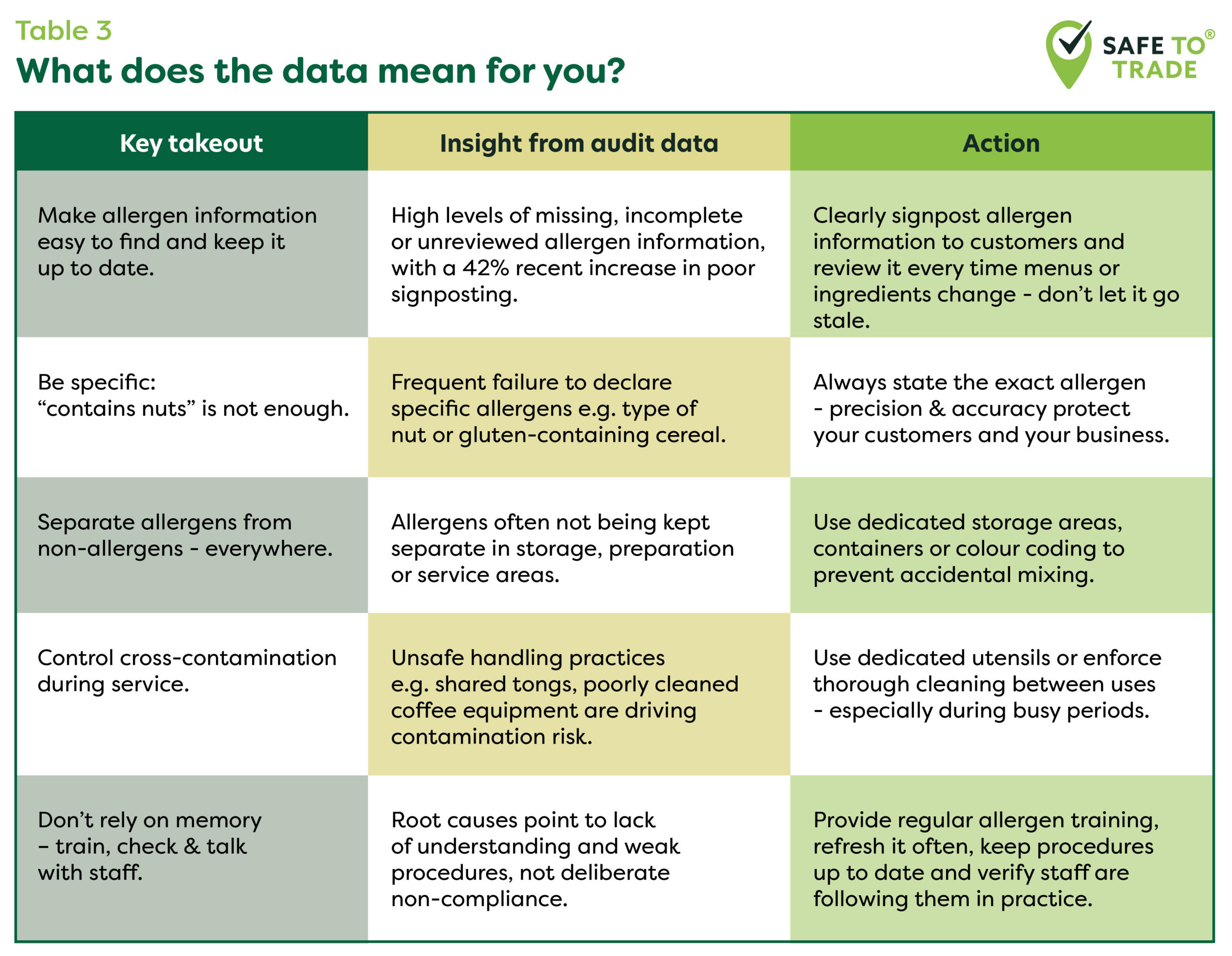
So the data has clearly highlighted the key areas of non-conformance being allergen information and allergen contamination risk, but what is the insight from the data. The key deficiencies in relation to allergen information were the lack of provision of allergen information, the provision of inaccurate information and the provision of insufficiently detailed information. All these elements are legally required and are indicative of any one or a combination of the following: a lack of understanding of the requirements, poor operational procedures to deliver the labelling requirements or wilful neglect to comply with the requirements. On the basis that businesses in the Safe to Trade programme have voluntarily chosen to participate, it is a reasonable assumption that most are unlikely to be wilfully disregarding the requirement. Consequently, it is most likely to represent a lack of understanding of the allergen requirements or poor operational procedures. These are two of the most common underlying reasons that drive non-conformances, but they are not themselves root causes. The reasons for an increase in non-conformances in the last 6 months are not entirely clear although this has happened during a period of significant business cost pressure potentially resulting in reduced availability of resource and investment in physical assets such as signage. Clearly, analysis of generic audit data cannot provide an answer to the true root cause of non-conformances and food business operators are encouraged to use structured root cause analysis to identify the fundamental reason that led to the non-conformance and, in doing so, implement corrective measures that will serve to prevent any recurrence.
In the context of a lack of understanding of the allergen labelling requirements, root causes may include no training in the requirements, poor training, poor understanding of the training or forgetting the training to name a few. Key solutions for these would include the provision of allergen training by competent bodies with associated assessment of understanding together with regular re-training and ongoing assessment of compliance and understanding by management review. The FSA provides a very helpful online training tool for food allergy and intolerance, designed for local authority enforcement officers but is also very useful for businesses.
Poor operational procedures that drive non-conformances in allergen information may be a result of a fundamental lack of structured management systems with a reliance on manual systems and individuals creating a single point of failure. But they may also be due to the lack of tools to do the job properly including both systems tools e.g. IT and physical assets e.g. boards, menus, signage, etc. Solutions include the implementation of food safety management systems including the Safe to Trade Standard with clearly documented processes for managing the provision of allergen information and regularly reviewing and maintaining the accuracy of such information especially with changing menus and associated ingredients. A variety of software solutions also exists to support the effective management of allergen information although it is equally possible to manage through conventional approaches. Similar to the non-conformances due to lack of understanding of allergen labelling requirements, the operational procedural failures can be reduced through regular verification i.e. checks that information is available and accurate plus continuous management review. Staff often have great insight into the barriers to effective compliance, be they operational (resource, tools, etc.) or system-based (processes, procedures, training) and talking to them regularly is key.
In relation to non-conformances that lead to allergen contamination risks to foods, the two key issues were the lack of separation of allergens from non-allergen containing foods and the inadequate handling practices leading to potential cross contamination. Although markedly different issues to the provision of allergen information, the underlying issues leading to allergen contamination risks have some crossover with a lack of understanding of fundamental risks and controls plus poor operational practices being common themes. However, it is also clear that operational pressures can significantly impact compliance in these areas where workload and lack of resource can lead to non-compliance with specified handling practices due to inappropriate prioritisation of service delivery over procedural compliance i.e. cutting corners. Separation of allergens from non-allergen containing foods can be enhanced through the use of separate storage containers or storage areas for allergen containing foods and / or through the use of colour coding. Similarly, contamination risks during handling can be minimised through the use of dedicated equipment and utensils that are clearly labelled or colour coded. Training, refresher training and management review and reinforcement are essential to embed good practice and the importance of procedures with documented routines and checks are essential. In addition to the training above, the FSA also provides a useful checklist on providing allergen information and avoiding cross-contamination in a food business for managers, kitchen staff and front of house servers together with allergen icons and posters that can be downloaded for free. In my first Data Insights article, I highlighted the importance of a strong culture of food safety and this is equally valid in the management of allergen risks. For those seeking further insight into food safety culture, the Global Food Safety Initiative (GFSI) recently published Version 2 of its position paper on “A Culture of Food Safety” and the Food Safety Authority of Ireland (FSAI) has an excellent “Guidance Note on Food Safety Culture” to support food business operators in implementing it.
Well, I hope this brief glimpse into non-conformance data has given you some useful insight but, importantly, has demonstrated the value of using non-conformances as a springboard to identify root causes and to drive continuous improvement in the food safety management system.
Look out for further articles on Safe to Trade Data Insights.
For more information, contact us here.
Please see the press coverage for this article below: